Texture Study or Digital Monoprint?

General / 12 May 2021


While trying out some new brushes today I began a little non objective painting. No plan, just making one move in response to the previous one. I'm starting a new book project and need to develop the visual style. So I was looking for brushes with that in mind. I'm trying to replicate the look of a painting surface with textured support and some dry brush just skimming across the uppermost surfaces. That's not something I've just passively come across digitally, I think I need to develop a way to create that, or else work both traditionally and scan in paintings to assemble digitally.


Usually i'm thinking about balancing the colors and the shapes. 


And then I wanted to interrupt this painting a bit and used some transforms to disrupt the structure. This process was slightly reminding me of Gerhard Richter's squeegee paintings all of a sudden. 


I've been playing with bevel and emboss to create relief texture within the individual brush strokes. That's an idea from artist Jama Jurabaev and it's fascinating to try to control. I started there with my new brushes, and used lots of techniques for painting and selections to try to create a surface that reminded me of heavy dry brush surface. I'm not completely sure that I've found something I like for my specific project, but it's certainly an interesting place to start.  

I started to think of this process as a digital monoprint. While monoprinting is really similar to painting, there is something that happens in the press and it can bake the surface together in a way that is different to straight painting. That slight bit of process that takes some of the image out of my direct control reminded me of the bevel and emboss settings on the layer style. I'm going to call this digital monoprinting and I'd love to hear opinions on that ;)


Plein Air painting for #PleinAirpril

General / 09 April 2021


I've been participating in a plein air painting challenge on Instagram this month. So far, it's been only en plein air in spirit because I have been working digitally indoors from photo reference (Just go with it). I've been studying some reference from the New York Botanical Garden of single flowers bunches, or views of the ground like this one. In a way it's a completely new approach to plein air because when I go out painting I find myself looking for some interesting effect of the light and then painting the scene as quickly as possible so I can get to capturing the lighting effect. 

But these references have mostly been tightly cropped and with completely flat lighting. So I really need to visually interpret what I am seeing, and usually bring some sense of organization other than the spotlight effect of direct lighting. The challenge, from my perspective, is to get bored enough with just getting the representation of the motif right or working, that you have to find another more specific way to entertain yourself with making the piece. Something like a specific moment where two colors come together, or maybe allowing the paint to feel like paint for like 75% of the piece and then snapping into detail and representation and sharp edges for the the remaining bit.    

It's really difficult for me to just allow a painting to feel unfinished, or under-rendered. I really enjoy creating textures and form in paint- usually that is the logic I use to make my next move. But at the same time I am trying to find a way of creating some looser and more painterly marks in my work and then allowing them to remain and not painting over them in time. Having those looser passages feels like a faster moment in the painting. Like a place where it is all just holding together in balance effortlessly, rather than meticulously. So this has been a really helpful practice with just that thinking. 

This little view of leaves started to feel like paint that I enjoyed looking at and actually reminded me of work that I was doing back during my MFA degree.  There is something here that I am trying to bring along with me for the future works. The challenge goes all throughout April so there is plenty of time to join in #pleinairpril. 

Non Objective Design

General / 01 April 2021


In 2d design we study the visual elements that make up an artwork and the principles that organize the composition. Then we try them out by making simple non objective designs. We analyze existing artworks such as poetry, music, and painting to see what elements and principles are making them work and if we can use some of those same combinations to create new original design. 


How can we visualize the structures and emotions of poetry and music? How can we understand the existing visual structures of artworks to engage with that same visual language? I wanted to really lead the students through this process to show them exactly how I might analyze an existing artwork with the intention of learning what makes it work and theorizing the process of how it might have been made. 


I started with this painting by Caleb Taylor from a recent exhibition of works at Haw Contemporary in Kansas City, MO. This is a very direct one to one example since it is a non objective painting being used to create a non objective design. I have my visual observations on the list on the right. It’s just observations of what I see. Then I used that observation to create an original design, looking for subtle opportunities where I can make a move that feels different from the source material. I have a lot of fun trying to get in another artist’s head and I don’t have a practice of non objective drawing and painting so it’s an interesting change of pace. 


My design based on an existing artwork :)

Teaching Demos

General / 25 March 2021


I'd like to keep a selection of my demos from teaching to share online. I'll start with this small black box still life I put together the other day. This July I will be teaching a refreshed version of my Digital Observational Painting course through PCA&D. I am adding a bit more of a focus on drawing and two dimensional design. Usually I skip quickly through drawing, since I teach painting, but drawing issues will always haunt your piece if you don't correct them during the process of painting. I want to focus the students' attention on design as a main source of expression in their work.  Our paintings shouldn't all look the same, even when working from the same motif. We will go through a series of exercises intended to open up a conversation about what our goal is in making a painting, or how our visual marks can tell the story of our visual  attention. 

Course description for my upcoming Digital Observational Painting:

Making a painting is a practice of both drawing and painting skills, but also one of design. While it is a visual problem to solve, there is not one correct answer, but an entire language of expression. This course will open a conversation into digital painting strategies and tools to grapple with the expressive challenge of visual perception. What are our paintings about and how can we make them visually legible? We actively guide our perception of the still life motif to focus around a design question, because while there are infinite ways to paint a still life, the correct visual path is the one that furthers and engages with our initial design question.

Moon Daggers

General / 05 May 2020


If the Moon Daggers are ceremonial objects, more than weapons, then it seemed like their place could be someplace interesting and more than simply a rack or placed upon a piece of furniture. They are kept out in the open, not locked away or in the darkness of a trunk, but within the garden under the open sky, in the shallow pool at the center. 


I tend to block out basic silhouettes to keep myself designing in shape until I’m ready to start painting and really visually knitting everything together. This way I can use these silhouettes as easy ways to create selections and masks as I need them. 


I tried quite a few shape designs when making this thumbnail. Really, I just didn't know what I was looking for so I searched and made these decisions while drawing. I make these thumbnails at about 2 x 3" so I am forced to simply stay designing in shapes and not think too hard about the details of what those shapes really represent quite yet.


Most of these just didn't have the right emotional tone that I feel is represented by the Moon Wytch. I kept thinking that I needed to balance cerebral, peaceful, and vaguely religious tones, but not dark magic or herbs or potions either.  

Grasslands Dagger

General / 14 April 2020


For this dagger I started with the shape of a Nubian Dagger from the British Museum. The silhouette is simple, while still holding my interest and it looks to me like the cut-out shapes in the handle are forming an eye. I imagined this one weathered and dried out, maybe it looked a bit different when it was first created.   


I think this will be the last dagger in this group, I’m going to get back to painting landscapes and environments for a bit.  It's almost Taurus season after all and technically I'm still feeling stuck inside!

Woodlands Dagger

General / 08 April 2020


This isn’t really a dagger is it? Maybe I should call it a blade? It is based on both an Egyptian Khopesh shape and I photo I found of two different trees grafted together with contrasting bark formations. I wanted to make something out of wood that still seems very green and alive to create a weapon of the forest. 


If this feels more whimsical or simply different in tone from the others, that’s mainly because the idea came to me while watching a Disney movie from last summer. I thought this film would be so sweet and fun, and it did have some sweet moments, but halfway through it was scary and sad, and the 100 Acre Wood never looked so spooky and depressing. I thought I needed to design the 100 Acre Wood Dagger: something brutal enough to protect me from the heaviness of that foggy forest, but maybe with a little bit of hope and charm for Pooh. 

Sun Dagger

General / 31 March 2020


I've been using snakes as a design element for much of my Wytches project and I had this image stuck in my mind for a snake head dagger. So I photo bashed one together, but it was looking too literal and not interesting to me. I liked the forked tongue and the opal gems in the rough concept, but I decided to leave behind the literalness of the snake imagery for this one. 


I traced the lines for the original concept, but allowed them to just remain as forms. I pushed the forked tongue into a more delicate, jewelry inspired play with curves. Even after this value design was finished I realized that I should drop the eyes and again just allow the form to be the statement. I think the solid white gems actually look more intense if you imagine them as eyes. They feel like they are in a trance or rolled back into the head, so something a little rare or less ordinary than simply looking out at you.


Glass Dagger

General / 09 March 2020


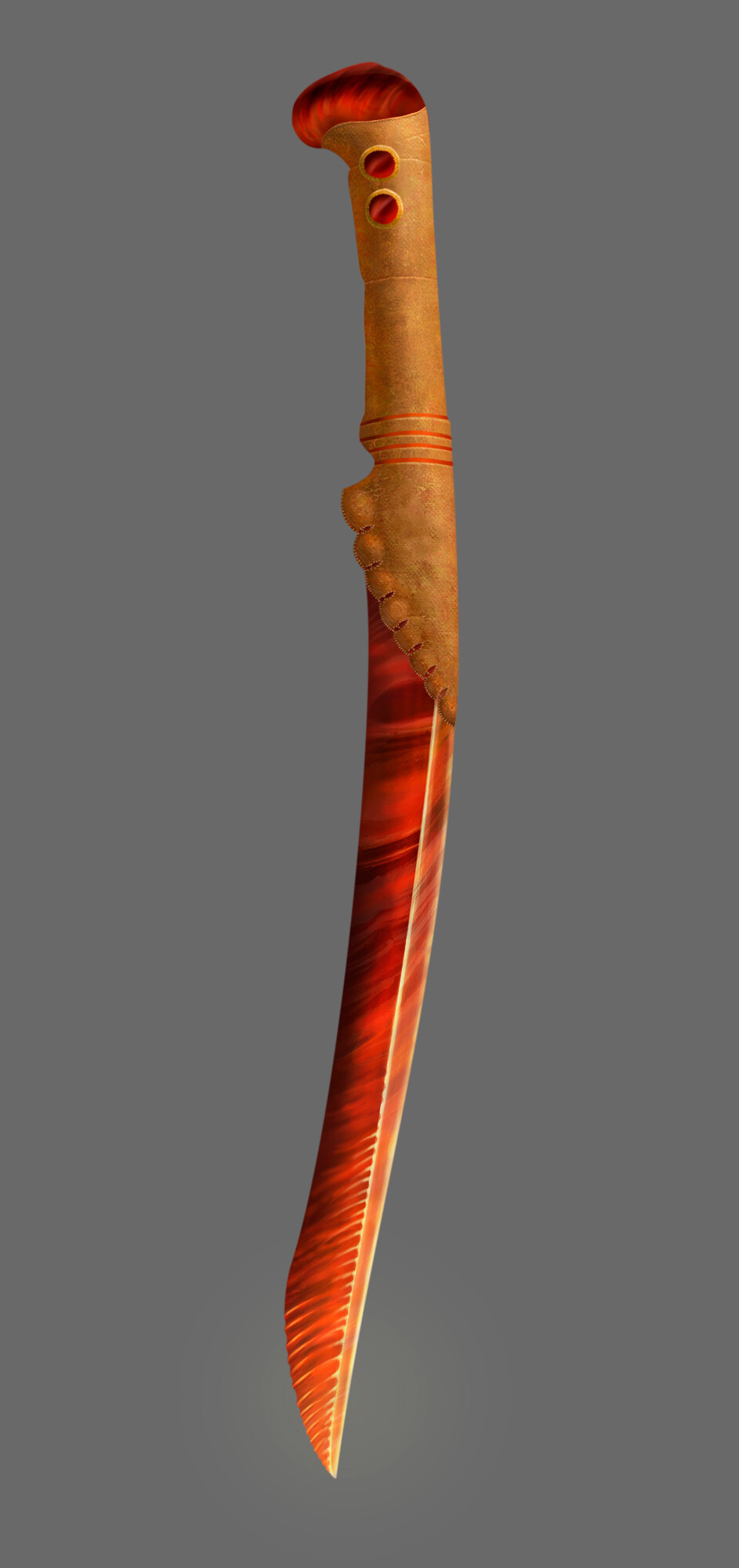
This dagger is based on a longer sword shape called an Ottoman yatagan. I like how focused the entire design is on the sleekness of the shape. To me, this brings all my attention to rest on the power of the blade, its use, and just makes it seem really mean. I wanted to create a blade made of a single piece of polished volcanic glass, wrapped with a leather handle. 


I imagine these daggers serving the same purpose as a wand for a wizard. They are a tool to focus the magical energy, so the materials become interesting and important for each character who uses the dagger. Where do they draw their energy from? There is also what I imagine to be a place of focus on each dagger, a place in the design that the user can touch or concentrate on while trying to focus their attention. For this one, the place of focus is the two round cutouts in the leather that expose the glass underneath. 

Designing a found dagger

General / 01 March 2020


This dagger is designed for a character I don’t really have a name for yet. I think of her as a feral person who lives on her own in a cave, or maybe a larger cavern and who doesn’t have everyday contact with others or with the sun. She found this dagger somewhere within her small world and has made it her own through use and binding it up with some wrapped fabric. This is an everyday tool for hunting and skinning small creatures and it shows. It is dirty and under-appreciated: there is history to this weapon and it wasn’t originally forged for skinning bats.